Award-Winning GMing Advice

Gnome Stew won the silver ENnie Award for Best Blog in
2011 and
2010 -- thank you for your support! Online since 2008, we've published
1,109 articles packed with GMing tips and advice, as well as
two books for GMs. Our
top 30 articles make a great starting point for new readers.
"I check Gnome Stew every day." -- Monte Cook
"fantastic blog for game masters, dungeon masters, and rpg fans" -- Wil Wheaton
"If you aren’t reading Gnome Stew, you’re missing out." -- Wolfgang Baur
“Is professor Yell doing this now, or wait, when did I plan to have him introduce that plot point. Oh crap, I was supposed to have the spider queen attack the group after they got the idol, not beforehand. Shoot! Who was it that sent the quicklings after the grey ladies!” My latest game is NPC heavy, and almost all of the NPCs are politically motivated ...
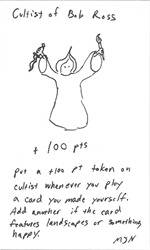
A card game that’s played by creating the cards with which it is played, 1000 Blank White Cards is a perfect game for those times when your group is between games or unable to play your regular game for whatever reason.
According to lore, 1000 Blank White Cards was created by Nathan McQuillen of Madison, Wisconsin. During a coffee run, he spied a box labeled, “1000 blank white cards” ...
This is part two of a two-part series on index cards. The first part dealt with using index cards during game prep, and included a brief overview of what kinds of cards are available, and how to store them. While no single approach is ideal for everyone, this article will focus on how I’ve been using index cards, along with some ideas that I’ve seen in use, ...
This is part one of a two-part series on index cards. The second part will deal with using index cards at the gaming table. Unless you’re new to gaming, or live and die by the laptop, you’re probably familiar with index cards at the gaming table. A stack fits in your hand, and they can be used for any number of things, from notes to character ...
Some GMs would never tolerate a computer at their game table; if a notepad worked for E. Gary, it’ll work for them. Some would be lost without a browser opened up to thirteen tabs, and multiple Excel sheets for calculating THAC0. And some, perhaps living out some brash fantasy as a librarian, swear by the lowly index card. So what’s the best way to run a ...
Do your players dig props? Do you want more props, but don’t want the expense (of both time and money)? Are you worried about what to do with the props? Do your players ever disagree as to exactly who had that potion? Here’s an inexpensive and effective idea that I’ve used.
Caveat: I borrowed this concept from the GM who brought me back into the RPG fold. Cool ideas ...
Excuse the cliché of telling you about my campaign, but that’s exactly what I’m going to do here. Except that this is about the techniques used to run the game, and not the clever divine dynamic or the really cool twists on the basic fantasy races. My last campaign was traditional D&D v3.5, which I ran almost entirely from a laptop, learning enough to write not ...
As GMs we tend to create a “toolbox” for managing our games and campaigns with. This toolbox changes and evolves over time. The toolbox is often eclectic in what it holds, with tools as simple as GM screens to high technology solutions like online databases. You can build a great game experience with just the raw materials of friends and a game system, but it is lot easier ...