48.png
 

Suggestion Pot

Want to tell us what to put in the Stew? We’d love to hear from you.

Request an Article

If you have an idea for an article or a topic you’d like us to write about, or a site-related suggestion, you can post it in the comments below (or if you prefer privacy, email us instead).

Please use the search box to see if we’ve already covered the topic you’re interested in — there’s a ton of material in our archives. If you can’t find what you need, let ‘er rip — and thank you for your suggestion!

When we respond to your suggestion, we’ll post a comment here to let you know that your article has been written (or why it wasn’t written). We’ll also credit you in the article itself.

(Looking for an old suggestion? In May of 2009, after the Stew had been online for a year, we archived all of year one’s suggestions here: Suggestion Pot: 2008-2009.)

162 Comments, Comment or Ping

  1. 1

    BryanB

    I’m still waiting for an inspiring article about Savage Worlds and its plethora of campaign settings. Surely there is at least one gnome that has this game in their rotation. :D

    Gnomed!Our resident Savage, Telas, wrote a jumbo article on this topic: Come to the Savage Side

  2. You caught me mid-move with the Suggestion Pot. I’m going through and marking completed requests, and compiling the not-yet-completed ones — including yours on SW. :-)

    I’m sorry we haven’t gotten to your suggestion yet, Bryan. I know we have at least one SW fiend among us, so I’ll prod him about it.

    The move won’t be complete tonight, but will likely be done by this weekend. Then we’ll be planning which suggestions to tackle and polishing up year one.

  3. 3

    Noumenon

    I just want to know how you deal with spells like Hypnotism, Charm Person, and Suggestion. Monsters you know the PCs are going to try to kill, but how do you plan for them to start controlling your NPCs?

  4. 4

    LesInk

    Suggestion for an article: A review/comment article on “A Quick Primer for Old School Gaming” found here http://www.lulu.com/content/3019374

  5. 5

    BladeMaster0182

    Hi guys. I would like an article on mapmaking. Every DM does it and I couldn’t find an article on it. I know many of us do it by hand but some of us (like me) lack the artistic talent to draw out their dream world. There are some map making programs, but most I have found are overly complicated, or do not look very good. How do you guys do it in your campaigns?

    Gnomed!Troy’s Crock Pot: A map-making groove is loaded with tips based on your suggestion.

  6. 6

    MattCruikshank

    I really enjoy reading Gnome Stew, and I have a suggestion / request.

    Two very closely related concepts:

    I’m a Software Engineer and in my tiny amount of spare time, I’m trying to work on a single player, computer roleplaying game. I’m looking for a few choices of fantasy RPGs in the Creative Commons, Public Domain or similar. (An “attribution” license would be fine by me, but I’d kind of like permission to use it in a commercial product, which some CC licenses don’t allow.)

    I saw a recent Gnome Stew article by DNAphil who said he was System Promiscuous. I’d imagine a few Gnome Stew contributors are cut from that same cord. I’d really appreciate it if they would spend some time reviewing their favorite CC fantasy RPGs…

    Then, there’s this other whole thing running around in my head…

    I enjoy D&D 3.0, and I’ve been a DM running the Temple of Elemental Evil for a few years now. I’ve made for myself a massive wiki on my personal laptop computer that is a huge reference and immense DM aid. Since I’m not sharing it with anyone else, I don’t think I’ve broken the law. I have a wiki page for each spell, for each monster type, for each room in the dungeon – and they all cross-link. Each spell wiki has an image which is from the scanned in PHB that I’ve cropped to have just that one spell… Ditto for the monsters… Ditto for the room’s text and the NPCs in the adventure… (I own legal, physical copies of all those books, and I’m not sharing this with anyone else, so I don’t feel too bad about it.) The room lists hyperlinks to the wiki pages of the monsters, the monsters list the spells and effects, the spell lists the other referenced spells. I’ve broken out the NPCs as well, and all of their abilities. I also have Excel Workbooks, where each sheet is an encounter. It helps me keep track of initiative, hit points, and current effects. At the bottom, I list the tactics and daily uses of each ability of each monster (and hyperlinks back to them), so I can plan out each round… Each monster’s label in my spreadsheet is a hyperlink back to my wiki for that monster / NPC. I have converted the maps into hot-link web pages in the wiki. THIS IS SO USEFUL!!! Why do we play an RPG that has a closed license?!

    If the mechanics of an RPG are an Operating System…

    Wizards of the Coast is Microsoft.

    There are a ton of Apples – creative, very good, and maybe you can even download them for free – but the publisher retains the copyright, so I can’t do anything like I’ve described above and publish it for the world to enjoy.

    Where is the Linux of fantasy RPGs?

    And if you pick one as a rallying cry, let’s make a wiki out of it, the likes of which even the very nice D&DInsider “Compendium” won’t be able to touch. Adventures and Campaigns can be made into BEAUTIFUL DM supplements that make running them A BREEZE.

    I’ve even considered trying to raise money to get a professional game designer to do some contract work to create the core of the gaming system…

    I’m pretty passionate about this, because I’ve spent a great amount of effort – but can’t share the results with anyone – and I’ve seen how amazingly useful it can be. I’d like to play in a world where we can all share and take advantage of this! DM’s of the world unite!

    -Matt Cruikshank

  7. 7

    Patrigan

    I’d like an article with regards to building a city. Tips and advice for drawing the floorplan. The important assets that any city requires (like mayor). And how to fill in specific story stuff into the city.

    The biggest roadblock is mainly the drawing of the map. I can never find a good road between too much and too little. And with nearly 0 drawingskills, this becomes really though.

  8. 8

    Reddo

    Hello, there! First off, I would like to thank you all for the awesome information-rich website you run. I’m going to start GMing a Campaign in Changeling: The Dreaming and it was very useful. I hope it’ll turn out pretty well.

    Then I noticed there were no Articles concerning Online GMing (which is exactly the type I’m going to). Online GMing is nice in that with it players and GMs from far away can all play together, also being easier for players that aren’t that far away from each other to getting close (Getting online is easier and faster than getting somewhere else!). Some of the programs I use the most are Fantasy Grounds (http://www.fantasygrounds.com/) and RiPG (http://sourceforge.net/projects/ripg). They are both nice tools and I believe most Online GMs out there may be using not-so-great programs (even I could have no knowledge over a better one than those two!). So I think a gnome-made Article would be of very help for a lot of people (especially I, that am new to GMing, online or not). Again, thank you for all the great info I already got on your website!

  9. This discusssion:
    http://www.enworld.org/forum/d-d-3rd-edition-rules/257592-i-want-believe.html
    is ridiculous.

    There are a few issues raised here.
    1. How much metagaming is acceptable?
    2. How separate should player and character knowledge be?
    3. And, to avoid the scandal in the first place, how do you structure events, particularly spot checks, sense motives, and saves against illusions, so that the players aren’t tempted to metagame in the first place? In my mind, you have to be at least as crafty as your NPCs. It’s no good having an illusion that looks like a duck if doesn’t walk like a duck and sound like a duck. There must be some issues of framing encounters worth thinking about.

  10. @MattCruikshank – FUDGE is the Linux… almost.
    http://www.fudgerpg.com/

    It’s as close as you’re going to find, anyway.

  11. 11

    MattCruikshank

    @Bercilac – have the FUDGE rules really not been updated since 1995?

    I’m drastically underwhelmed with the way FUDGE is currently presented on the internet. Perhaps if a few Gnomes jumped in and helped, we could give it a nicer face.

  12. 12

    BigYAvenger

    Hackmaster Basic was just released. I’d really like to see it reviewed on Gnome Stew!

  13. 13

    whodo_voodoo

    A rather open ended suggestion but do any of the gnomes have advice on writing up an adventure that other GMs could run? I’m currently in the process of writing up a Demon Hunters adventure and finding translating my game notes into a written and ordered format rather more challenging than expected.

  14. 14

    Crushnaut

    Right now I am running a Vampire’s game with five of my friends. This was a our first adventure into gaming since we played DnD about 6-7 years ago. We play once a month, and in between sessions we play one-shot games based off the base World of Darkness rules with different players DMing.

    The game started off well. Everyone seemed excited about playing, but now I get the feeling that my player’s interest has waned, although they do not seem to want to admit it. I ask the players if they are enjoying the game and they tell me, “YES! It is great!” But, then during the games they do not seem to pay attention. They seem more interested in having side conversations, falling asleep, or their favourite, drifting off into space. I try to rein them in but eventually I feel like I sound like a broken record player, or my mother nagging me.

    For example. In our last game the group killed a bunch of women they picked up at the bar. I decided that they way they did this was very sloppy, and would probably draw unneeded attention to the group. Since the group did not seem to think that the Masquerade was a good idea I had two old Vampires, one Cirlce of the Crone, and one Lancea Sanctum, come and have two seperate Vampire philosophy sessions with the Player’s. I thought it was a great idea as the two views are polar oposites and I thought it would give the players a good look into the world of the Kindred. And since they seemed interested in posibly joining these covenants I thought, perfect. They will learn more about Vampire unlife, more about the covenants they are interested in, and hopefully learn to obey the masquerade.

    All the players said that these conversations were really well done, and that it couldn’t be improved; however, during the conversation, one player was drifting in and out of sleep, one was doodling, and the others just didn’t seem to be paying attention. I tried to lead them along a Socratic dialogue, but when the elder Kindred asked them questions they just kind of hummed and hawed, and never really had an answer, or just did not really seem to want to interact.

    So, this is the problem I have. I have players telling me the game is awesome, but to me it seems like they feel playing in the game is a chore. This effects me because it is no longer fun to DM as I do not feel the players are having fun. It makes me not want to spend time preping my games because I feel the players wouldn’t notice the difference between a prepared game and a winged game. Also, it becomes hard to hide suttle clues in the dialogues they have with other Kindred because they do not seem to pay attention.

    Thus, my question is what do I do when my player’s do not seem interested in my games, but continue to tell me that everything is fine? Is it time to give up on this group?

  15. 15

    Scarecrow

    Last night I finally ran my first game of Star Wars Saga. Everything was in place. I knew the rules, I knew the scenario. I was ready for them to fail aswell as succeed. I was prepared to say ‘yes’ to the players and let them go off at a tangent rather than railroad them.

    The game was as dull as dish water. They aced all their rolls (despite making the DCs quite high – usually 20) and breezed through the scenario without any real challenges atall – except for one totally overpowered combat (but that’s another issue).

    The problem as I saw it was that I didn’t complicate their situations at all. Sure they made their checks but that just made for a dull game. They needed to succeed at a cost.

    I’m a great believer in complications rather than obstacles, but I am definately not quick-witted, cunning, devious, malicious or generally twisted. These are essential qualifications for a good GM, I feel.
    So I was thinking that a Gnome Stew post on ideas, suggestions and tips on ways to complicate situations (especially non-combat situations) for your players would be useful and interesting.

    Cheers,

    Wayne

  16. 16

    temenok

    Kind of related to Crushnaut’s suggestion:

    How can you know when you, as GM, are being a jerk/bully? Speaking for myself, I always talk with my players after each game session and see how they reacted to it, so I sort of have a pulse on how they feel about the way I’m GMing. But there might be clues I miss.

    Having played/GM-ed for 30 years, now, I’ve seen a lot of bullying GMs, and real jerks behind the screen. However, I’ve got biases and opinions, and am curious about others’ biases and opinions on the matter.

  17. 17

    BladeMaster0182

    Hi there. I’m about to start up a Shackled City campaign with my DnD group. It is an award winning premade I found and I’m eager to run it. While I love making my own campaign, premades give me a lot of new ideas and do two things that take up the most of my prep work, map drawing and stating out NPCs.

    However, the issue I had with my last premade was that it was too railroady. There was often only one or two solutions and this frustrated some the players. While I have no problem with linear story lines (all stories are linear in some way,) I do like giving my players some freedom.

    What is the best way to make a premade less linear, without completely having to rewrite sections of the story?

  18. 18

    brcarl

    One of my groups is dealing with an AWOL player. We’ve tried to contact him a few times but haven’t gotten any response. As it’s a play-by-post group, we don’t have the option of physically checking in with him.

    As the GM, I’ve decided that he’s been absent long enough that we need to replace him. (Nobody wants to run his PC long-term.) The new player I’ve got ready to go, but I’m struggling with the exiting player: I don’t want to just kill off his PC, as he was a good player when he was around. We’re hoping he’s just dealing with lots of RL issues, and I’d like the option of bringing him back in if he returns. I’d also prefer an exit that makes sense in the current plotline, and isn’t blatently contrived (ie., he disappears mysteriously in a puff of smoke).

    How should I handle this?

  19. 19

    Zaraphina

    I’m a fairly new DM with a problem. I have a HUGE PARTY. I’m not exaggerating. My whole party is about 13 people, with 7-10 showing up regularly. It’s sort of my fault. I wanted to have a big enough group so that even if half the people were gone i could still run. I kinda expected that by now the party size would have gotten smaller (due to scheduling conflicts, etc.) but it hasent. The game is going fairly well, everyone is excited to come back everyweek. so I’m not looking to downsize, (plus it’d be rude as I personally asked them to come), but am looking of r some tips on how to manage such a large party.

  20. 20

    Zig

    Hi, Guys.

    Something I would find very interesting and useful would be a collaboration article from all of you about one unique magic item you have each had in a campaign you ran.

    Also I think the comments for such an article if you asked the readers would be interesting reading and certainly useful. I, and I assume most GMs, are always looking for good ideas that have worked for other GMs.

    Thanks!

  21. 21

    CanadianHobo

    I’ve been GMing for a fair amount of time now, and it’s just getting to the time to wrap up another campaign. None of my players though want to pick up the mantle of Game Master (A fact that frustrates me as for the past 3 years I’ve not been able to actually play in a game). It seems impossible to get them to understand that while I enjoy each and every session I run for them, it takes a lot of work to get it all together on my end. I’d find it interesting to know how the Gnomes would handle such a situation.

  22. 22

    MattCruikshank

    @CanadianHobo – you could try picking a roleplaying game without a GM. I’ve heard of them before. Or try to get each of your players to GM for one night, each. Or try using Pathfinder Adventures, or some other completely prepared Adventures (to minimize prep time for you). Or see if anyone in your extended social network would be willing to come GM for you guys for a while?

  23. 23

    jreyst

    Hey guys – I’m the original creator and prime motivator/promoter of http://www.d20pfsrd.com which you graciously linked to in an article on Pathfinder several days ago. I was wondering if you might take a few minutes to write up a review of the site as it is today, including the many features we have available on the site. I’d love to hear your thoughts, pro or con, in order to improve the site.

    Thanks,

    John (jreyst)

  24. 24

    Tabulazero

    Hi Guy,

    I would love an article highlighting how you organise your DM notes? What do you write? In which order? On what support? Any tips you could share?

    Would love to know how you approach dungeon crawls and more event driven adventures?

  25. 25

    Crushnaut

    I did a quick search of the blog and couldn’t find an article on this topic. If I am wrong please let me know.

    Anyway, I thought this could be a good article. How do you know when you have a player that is just not worth having at the table? What are the signs? How do you know when its not just bad DMing on your part?

    Thanks!!!
    Phil aka Crushnaut

  26. 26

    Jimc

    Hey Guys,

    I actually a couple of questions/suggestions/topics for thought, all from one game idea.

    A while ago a friend of mine had an idea for a game about dragon riders. The game never actually happened; I think he couldn’t find a system he felt would allow his vision to play out happily.
    So first up: What if your homebrew setting idea doesn’t fit into an obvious system?

    The obvious idea was to play using any system and just giving your fairly typical each player a loyal dragon companion, the issue here is that he wanted the dragons to be fully fledged personalities in themselves. So how’d this be possible? In essence how do you have recurring and powerful intelligent, but essentially loyal npcs. How do you manage when a players mount, rather than a well trained warhorse is fully intelligent and able to (and should) question what’s asked of it? A similar question can be asked about systems which have intelligent familiars?

    Final question is about the other way of handling it, ; the Dragon is played by a player as is the rider. How could you handle such a potential disparity in PC ability?

  27. 27

    sealer04tx

    Hey Guys,

    Thanks for the hard work and all the great posts. I’m currently running a DnD 4e game and your site has been a big help. I was wondering is you had any ideas about how to incorporate war into DnD 4e: characters lead troops? fight bosses? fun mini-games?

  28. 28

    Patrigan

    might I request some elaborate examples and tips to use Stross’s Law.

    I really like Martin Ralya’s article surrounding this and it has been an awesome tool to create several things, like races, events, places and so on.

    But a fresh view on it (or a review of Ralya himself on his old view) would be awesome. It’s also a great tool for many aspiring worldbuilders.

  29. 29

    trisj

    I would like to see something more specifically addressing how to run play-by-post. Places that support this type of gaming/good tools to use, ways to keep your players updating, problems one would face specifically with this medium vs. table top, systems that are better for this than others…yeah.

    That or ‘What’s a GM to do when there is nothing to M?’ People move, things happen and unfortunately one can’t always run games. Besides the obvious picking up of the XBOX controller, what are some good things to do to keep those thoughts going and juices flowing?

  30. 30

    Great_idea

    I have been GMing a group for about a year and a half now. It started out with me playing with my close friends, who are all very good, very fun players to play with. Over time, my friends brought in their friends, which I encouraged, and over time, they brought in their friends. We had an unwieldy huge party for a while (It was not unusual for twelve players to show up), and we tried to split it into two smaller groups, but nobody but me was willing to commit the time and energy to GM regularly.

    Eventually, my original core players started leaving the group. Some of them didn’t like the size that the group had ballooned to, because it made everything take forever, and reduced everyone’s spotlight time to practically zero. Some of them didn’t like the playstyle of the newer players, who were combat-hungry minmaxers while the original players had played light, humorous, but roleplaying-heavy characters.

    At this point, the party is down to a manageable size, but I’m no longer playing with my friends. I’m now playing with people I don’t really know, and I don’t really enjoy their playstyle very much. They are not people I would spend time with outside the context of the game, and I feel a little cheated that I am having to adjust my style to suit their wants, when I started out with a group that shared my interests exactly.

    I just finished a fairly long campaign (with only one of the original players), and I’m currently taking a break while some of my players run short adventures and mini-campaigns. I had kind of hoped that this might encourage one or another of the players to take on a major campaign of his own, and maybe take the new crop of players with him, allowing me to go back to my incompatible older group. This is looking less and less likely as they fail to prepare for their sessions, and their adventures are generally treated as inferior to my “official” ones.

    Anyway, I’m preparing for my next campaign now, and I’m just not enjoying the prospect of returning to the other side of the screen with these players. I want to play with my friends, and with players who are interested in something other than killing monsters and taking their stuff. Is there any good not-hurting-anybody way to get my favorite players back (without adding another high-preparation, time consuming weekly session), or am I stuck catering to the players who still show up?

  31. 31

    Havukin

    Judging by the comments on many articles this site has a large community of intelligent and experienced GM’s reading it. At the moment you encourage us to participate by discussing things in the comments (and by using the suggestion pot). Have you thought about asking for and publishing full articles by the readers? Maybe hold a GMing article contest or publish a guest article of the month. This would probably cause some (lots of) work on your part because you would have to act as editors but might be worth it.

    I at least have had ideas that I would have gladly shared with the whole community as articles, though I’m not sure if I could actually create anything I’d think of as good enough to send to this site.

  32. 32

    trisj

    Not a suggestion for an article and potentially impossible but…

    …is there a way that you can make your links to other sites open in a new tab instead of drawing people away from the article? It’s something minor and something people can get around with a few extra clicks but…if you can do this, I think you guys should.

  33. 33

    fanta

    Hi GMs! Im currently running a D&D 3.5 campaign & I Have some issues because they`re all SO LEGAL GOOD (in a WARMAMMER 4k`s Space Marine way) that in the end its inevitable they turn to EVIL, so here is the poin of my topic.-

    How can a DM deals with a PURE EVIL PARTY?

    I must admit, I feel kinda sad for the destiny of my NPC & their families in the last session althrougt it was memorable because the twist of the plot made by the PJs.

    Im concern about the plot twists that makes me throw all my preparation & lead the camapign ON THE FLY. Im kinda easy this way, the thing is: Im running out of towns because are all burned down ´cause my party tends to judge them as “heresy towns”.

    TXS!

  34. 34

    bif

    I’d like to see an article about:

    Imagine a ‘friendly local gaming parlor,’ which carries little inventory and pays its expenses through a mix of hourly game room rentals, membership programs, consignment space, and by-order retail sales in order to offer a comfortable place for gamers to gather. Could such a business survive?

    This article (http://www.shirky.com/weblog/2009/11/local-bookstores-social-hubs-and-mutualization/
    ) speculates on what bookstores might do to compete with online retailers. I think it applies to FLGSs.

    The article basically says that bookstores aren’t compensated for much of the social value they provide as side-effects to their bookselling. To compete with online retailers, these bookstores might find ways to emphasize and monetize these social aspects through memberships, endowments, consignment fees, etc., becoming the ‘NPR’ of reading.

    I don’t know if this is quite within the editorial scope of your blog, but I’d like to see the idea circulated a little within our community in case it inspires someone to give it a try. Alternately, is there a blog more focused on the industry aspects of gaming where this article would fit? Am I already behind the times on this?

  35. 35

    Zig

    I had a question about how other GM’s deal with a player base where you can’t rely upon all of them being able to show up on game day due to real life issues — spouse, children, other interests, etc.

    My second edition D&D game has been on hiatus since end of spring. Normally I’d be able to ramp the campaign back up now that Summer is over, but that hasn’t been.

    I’m feeling the GM itch and what to run a game for my friends once again. Going back to the last campaign could cause problems as essential characters might have the players running them missing gaming sessions.

    I could also start a new D&D campaign, or go to another game like Shadowrun which I have run in the past. The problem I would deal with there is that I could never be sure which players will be able to show, and some of them give notice of a day or two only making it difficult to plan out the adventure. Example, putting a number of traps around for the rogue character to deal with and have his moment in the sun…but if he doesn’t show up I have to ditch the traps or find an npc to join the group.

    How do other GMs deal with this issue. I’d appreciate any ideas either from one of the Gnomes and of the other GMs who read this site.

    -Zig

  36. 36

    Crushnaut

    I would like to work a rival, or re-occuring adversary into the next campaign I run. How do you guys work these into your stories? Do you use the powerful, yet utterly hopeless defiler as seen on TV? Or do you use a truely threatening foe?

    What if, to your best efforts, the PCs kill their nemisis before you are ready for that dramatic final show down?

    Do you find rivals and reoccuring villains to be an effective way to add that extra something-something to a campaign?

    Thanks.

  37. 37

    bif

    OK, I’m back with more esoterica:

    http://www.animationarchive.org/2010/01/gustaf-tenggren-and-genesis-of-golden.html

    This article about a successful children’s book illustrator has a lot going on, but the part that struck me was how his art developed from full-page illustrations to ‘floating’ the subjects against the white page background in what was to become the ‘golden book’ style.

    Its value to GMs can be summed up by this quote from the article:
    “Instead of busy backgrounds full of details, he used just enough information to place the characters, and focused his attention on composing the figures.”

    This concept is tossed around among GM advice blogs, especially as it relates to world building, in the form of ‘getting the most of your prep time’ and ‘the PCs are the stars of the story,’ and so forth. The illustrations used as examples in the article nicely sum up the concept visually and offer it a fresh persective, and are painted by a well-regarded master of his art.

  38. 38

    hattymchappy

    I’ve just started a new play-by-post 4e campaign and I already fear that it is going to implode. The main problem is with one of the PCs. I, as the GM, and a couple of the other players have a problem with her. She is a “Mary Sue” and frankly, she’s really annoying. Now I’m all for anyone creating any type of character that they like, and I want all of my players (including myself) to have fun. But this “Mary Sue” I KNOW is going to try to hog all of the spotlight, and she’s already acting like she’s above everyone.

    Usually this could result in some interesting roleplay between characters, but in real life my other two players have little interest in having to interact with such a character. (And they are actually reluctant to post so that they won’t have to.) What do I do to make all of my players happy? I don’t want to tell the problem player how to play their character, but I need the other players to WANT to play with her.

    Are we just being whiny, intolerant jerks? Or do we actually have a point? Any advice would be super helpful. I just want everyone to have a good time.

  39. I would like to see something about Star Wars Saga written up, there seems to be very little critique of the system on the Nets outside messageboards and my own blog. And given that the current publishing run is ending rather soon, perhaps someone could take a look back at the system as a whole and what could be done in the future.

  40. Why, a review of the RPGPundit’s GnomeMurdered RPG of course:

    http://www.pigames.net/store/product_info.php?products_id=553

    And the 2 of you should do some cross-promotion.

  41. @AvatarArt – I’m not sure if we’ll do a review, but we have seen this game. We’re surprised no one has done an “all gnomes, all the time” RPG before, actually!

  42. 42

    trisj

    You have reviewed various programs/apps that can help GMing; how about a compiled list of “Apps for your mobile device you must have,” or “Tiny proto-robot makes killing PCs easier (I jest).” Most people have some kind of smart phone these days and not everyone wants to bring their laptop.

    It would be nice if the list was not iPhone-centric.

  43. @Martin Ralya – Good point. But why didn’t you guys do one? :)

  44. @AvatarArt – We went in a different direction for our secret project — though a gnome RPG would be a ton of fun to develop. Maybe down the line we’ll tackle that one.

  45. 45

    LesInk

    Dear Gnomies,

    I believe I have been a victim of the suddenly-appearing-railroad scenario. There I was GMing my last gaming session when I found myself in a scenario where I thought the players would be forced to a desired endpoint where they are captured. Low and behold, the players were able to keep fighting off the rounds and rounds of sleeping gas (4E game mechanic wasn’t working as well as I would have liked) and just when most everyone was knocked out, another was jumping back up (can’t fudge the dice, they get to saving rolls). In this scenario, they were also trying to break through a grating to a pipe they had entered through and escape. The problem was I have this wonderful next scene that depends on the characters to be knocked out and everything depended on it. This isn’t my normal mode of operation, but we are experimenting with more cinematic games. Eventually, one of the players pulled out an obsidian horse and used it to pop open the gate and they fled. I could have introduced a very heavy hand to forced the ending to work in my favor, but I decided the characters earned their reward of escaping — they had already been put through enough.

    The game ended there for the night and we talked a bit while I stewed over some possible new next scenes. I bravely piped up and asked the players if they would mind letting themselves get captured if I assured them of a few things that would happen (namely that they would wake up alive and still have their equipment). To my surprise, they agreed knowing that I was working up to something worthy of playing out.

    So, here I come to my quest for advice — when you have something that you need to happen, what are some tips on making it seem pausible without offending the players? And what do you do when you thought the odds were all in your favor and they suddenly go sour?

    I should also point out that I also dislike railroading, have read http://www.gnomestew.com/gming-advice/railroading-it-encourages-nothing and http://www.gnomestew.com/gming-advice/in-defense-of-railroading, but believe that sometimes you really need the players to turn left instead of right even when you want the illusion of right to be there.

  46. 46

    Salbic

    Is there a way to “nudge” a GM who’s unwilling to change or grow?

    In this case, we’re all pretty new to roleplaying. Our GM rejects any gamerunning-related reading (articles, blog posts) I suggest, and even brags that he hasn’t read the GM’s manual for the game we’re playing — he’s afraid that any new perspective would “change his style.”

    It’s not that he’s bad. We’re having fun most of the time, and he’s got a good grasp on the rules. But just because his approach works with this game and this group of players, doesn’t mean it will work with others, and I’m afraid that by ossifying so early he’s limiting future possibilities for all of us.

    I’m his assistant (away-from-table duties — photocopying, player liaison — only), and I feel like I know more about GM’ing than he does. I don’t want to attempt a coup; I just want to share some of that knowledge. Are there any strategies to make him listen?

    Note: If I come off sounding a bit patronizing or possessive here, it’s because he’s my younger brother.

  47. 47

    AJSB

    Hey guys,

    Despite being a player predominately (and only occasional part time GM), I’m loving the site.

    My suggestion is thus: How much do you use minis to represent the game? Having played in two different groups recently, one where minis were used pretty much all the time, the other the exact opposite, I now find myself leaning towards no minis. I find I have a much, much clearer visual idea of the game, battles and characters when I’m not staring at a bunch of figurines on a grid. What’s your experiences? (Obviously the type of game will make a big difference here. Crunchy D&D might not lend itself to no figure action.)

  48. A website worth checking out!

    http://www.cartographersguild.com is a forum dedicated to the art and science of fictional cartography, especially for novels, online games, RPG games, board games, VT games.

    Most major industry cartographers are members, many up-in-coming cartographers, and amateurs too. Over 20,000 members.

    Many tutorials on creating maps using a huge variety of applications (as well as hand-drawn maps) from GIMP, Photoshop, Illustrator, Xara Xtreme, Profantasy software, etc., etc.

    Hundreds of maps usable for non-commercial use in private games. Publishers and individuals can get maps commissioned for free and for pay.

    I’m a senior member there – same User Name as here.

    Check it out!

    GP

  49. 49

    Roxysteve

    I recently got kicked out of a game with which I had become disenchanted. The game was set in the dark world of Conan’s Hyboria, with all the baggage that implies, but gradually morphed into D&D without the elder races.

    The problem was that this rendered the character I had developed a complete waste of time as his fundamental beliefs became groundless in an increasingly consequence-less world. In short, I felt disenfranchised and cheated by the DM (everyone else was having no problem and probably thought I was being a prick for no reason, I should add).

    I would like to see an article on the need (or lack thereof) for “keeping faith with the players” as far as game world mechanics goes. This goes beyond the “social contract” articles I’ve seen here.

    If it’s been done, I’d appreciate a link.

    Ta.

    Steve

  50. 50

    Inumo

    As a first-timing DM, one thing that I’ve noticed lacking in many first-time-DM articles is just the basic, taken-for-granted stuff; how to use secret information, how to paint an environment picture, easy ways to keep track of initiative/char. stats/etc. for all the PCs and monsters, how to avoid MMO-style number-crunching, that kind of thing.

    Hope that helps!

  51. 51

    Sigurd

    I’d love to see an article about book publishing. Who does what? What are their expectations? What are the timelines and constraints?

    It would be interesting to get a view behind the scenes – perhaps the production history of a well known publication.

    Its easy me as a reader to finish a pdf and think “they should have improved….”. I don’t even know how many contributors get to read the whole thing before publication and what their constraints are.

    Publication pressure has to limit some ambitions. What are typical compromises? As a reader, what should I be understanding of?

    Sigurd

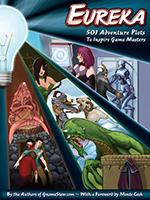
  52. @Sigurd – We decided this was a better fit for the new Engine Publishing blog — Engine is putting out Gnome Stew’s upcoming book, Eureka. Publishing is a great topic, but it’s outside the Stew’s niche; we’re solidly GMing. Thanks for the suggestion, and I hope you’ll check out the EP blog. :-)

  53. 53

    AquaFox

    Hi.

    I haven’t seen many articles that give good insight on the GM screen. Its usefulness, what it’s there for, what its alternatives are. I would love to see an article like that on Gnome Stew, since I have not seen anything similar anywhere else.

    Thanks.

  54. 54

    skravelle

    I’m about to start my first campaign as a DM! One small problem- I have too many ideas! The general idea of this campaign is shenanigans- see how crazy and silly we can get. How do I narrow down my scope? Have any of you ever had such a plethora of ideas you didn’t know where to start?

    Thanks!

  55. 55

    LesInk

    I’ve finally came to realize that combat doesn’t have to be just about “kill or be killed”. In fact, I have taken this a step further and realized that combat is just one method of conflict resolution (skill checks, skill challenges, and conversation being the other ones). The reason you get into a combat should (usually) be because there is a higher level problem to be solved. However, like any good story, resolution may introduce complications. Here is a simple example:

    The players need to get the magic artifact from the BBEG. The BBEG naturally does not want to give it up. Combat ensues. The BBEG, seeing he is about to be defeated (players take too long to get him), breaks the artifact. Now the story turns into finding a way to replace/fix/circumvent/etc. the artifact.

    Of course, there are variations on how the ending could be. Even if the players took out the BBEG and artifact, the mooks may decide to chase down the players later; the artifact may be trapped; the artifact was a fake; a mook escapes with the artifact; and, etc.

    So, this leads me to a question not only for the veteran staff of Gnome Stew, but also to our readers, “What is 101 ways to use combat for conflict resolution that is not all about kill or be killed?”

  56. 56

    zoggynog

    So, I’ve been struggling with using “custom currency symbols” in excel to show currency in the Platinum/Gold/Silver/Copper Format.

    Sure, at the end of a price you can write gold, or gp, or whatever…but good luck sorting that afterwords.

    I’d love to see a tutorial on setting up Excel to view currency as “12pp, 1gp, 12sp, 10cp” and have it be able to sort prices from low to high.

    Honestly, I use excel for little more than a glorified table, or I’d jump in with my own tutorial.

    Any excel guru’s up to the challenge?

  57. 57

    Matthew J. Neagley

    @zoggynog – Use one cell to hold the value of the currency, formatted as a general number so that places, starting on the right and moving left hold cp, sp, gp, pp. Thus, 127pp, 7 gp, 3sp, 9 cp would be 127739. Now, put this formula in a nearby cell =concatenate(mid(CELL,1,len(CELL)-3),”pp, “,mid(CELL,len(CELL)-2,1),”gp, “,mid(CELL,len(CELL)-1,1),”sp, “,mid(CELL,len(CELL),1),”cp”) Where CELL is the cell with your number in it.

  58. 58

    SC

    I’m fairly new to PnP RPGs (new enough, in fact, that I’ve yet to actually play one… but no matter) and I’m starting in the usual place – D&D. Of course I already have delusions of running a campaign myself. I’m currently doing a first read-through of the three original 4E core rulebooks, and I’ve noticed a bit of a problem. Ideally, I’d like to run a low magic campaign (or at least a campaign where not everyone can up and fly, which seems to be the D&D default), but the way that PC abilities are described is very, well, magical. Now, I don’t mind having a magic user throwing spells around, since that makes good sense. But a lot of basic melee attacks and the like seem pretty magical in nature, even for fighters. I’d like to be able to keep the powers available for use, but describe them in non-magical ways. Either that, or disallow some of the more fantastical ones.

    Then there is the issue of healing surges. The way that I’ve justified them in my head is a PC bandaging himself, or a PC centring herself for a surge of adrenalin… but again, power descriptions get in the way. They’re just too fantastical, especially some of the Paladin’s and Cleric’s prayers.

    Is there any way to get the low-magic, hit-things-with-a-mace rather than hit-things-with-a-spectral-sword-you-conjured-from-your-god feel that I want without gutting the rules or really annoying players?

  59. OK, the great Suggestion Pot Roundup and Blitz of 2010 is now underway! In order of appearance, here are links to articles based on your suggestions, along with response in those cases where we won’t be writing an article. (Many thanks to John Arcadian for compiling this list and writing many of the responses!) :-)

    My apologies for how long many suggestions have gone unanswered, and for not noting the many that we did write here in this thread. I run the joint, and it’s my fault that this system wasn’t working the way it should have.

    As you can see up top, I’ve changed the way the Pot works slightly, and I’m also subscribed to this thread. Whenever a suggestion is made here, the site sends me an email. I’ll check it out and either respond right away (generally if it’s not right for the site, and we don’t be writing an article about it) or send it directly to the gnomes’ mailing list so someone can tackle it.

    Hopefully this will result in prompt responses and a more direct link between making a suggestion and seeing it written up for the Stew. :-)

    @Noumenon – Gnomed! D&D Burgoo (3.5): What a charming suggestion

    @LesInk – Gnomed! Review of the “A Quick Primer for Old School Gaming”

    @MattCruikshank – As far as your two questions go, they’re pretty hard to get definitive answers to. Were it not for some disputes early on in the process, all of the fallout computer games would be run using GURPS.

    For free and open source tabletop RPGs, check out John Kim’s lists.

    For a Gnome Stew article that compares various RPG elements to computer operating systems, check out John’s piece on how Building a Game Campaign is Like Building A Computer.

    @Patrigan – Gnomed! Troy’s Crock Pot: A map-making groove

    @Reddo – Gnomed! While not a direct response, DNAphil has covered some aspects of this subject. He just recently put together an article about Skype At The Game Table: A Primer. He also wrote one about using Google Wave called Insert Catchy Wave Title Here.

    @Bercilac – Gnomed, at least in part: How Much Metagaming is Too Much?.

    @BigYAvenger – DNAphil reviewed it after picking it up at GenCon: Part 1 and Part 2.

    @whodo_voodoo – Try my recent review of the Kobold Guide to Game Design v.3 on for size — that book has some great stuff to say about adventure creation.

    @Crushnaut – Gnomed! This went straight from my inbox to the site: An Unpleasant Truth: Your Players Have Stopped Enjoying Your Game.

    @Scarecrow – Check out John’s Making Challenges That Your Players Love To Beat and DNAphil’s How To Make Skill Checks Not Suck. :-)

    @temenok – John says: Knowing if you yourself are being a jerk/bully is really hard as a Game Master. What you may be doing to keep balance or continue the game might cause players’ to think of you as being unfair. There is one key thing that I can think of that will act as a sign: when your players aren’t having ANY fun. However, you might want to give yourself a GM Performance Review. Also, Kurt’s Killer GM or Selfish GM and Scott’s article on The Perfect GM are good places to look.

    @BladeMaster0182 – John says: Premades are great for getting everything you need to run an easy prep game, but they can be a bit linear. Your best bet might be to treat the premade more like a splat book than an adventure. Cherry pick it for ideas, locations, and stat blocks and work in your own story that deviates from the published story wherever it needs to. Whatever you do, be sure to make notes about what changes you make. You might find these articles helpful for cherry picking some ideas:

    Nonlinear (Sandbox) Games
    Island Design Theory

    @brcarl – The answer really depends on your campaign, and only you know best what will work. You’re on the right track already, so I recommend: 1. finding an organic, in-game-appropriate way to exit the PC non-permanentaly, and 2. telling your other players that’s what you’re doing, and why. It’s in everyones’ interests for this player and PC to be gone, so your players will understand.

    @Zaraphina – Covered by Five Ways To Deal With A Too Large Party. :-)

    @CanadianHobo – John says: With an admittedly slightly misleading title, Johnny’s Five – Five Ways To Get Your Players On The Other Side Of The Screen tackles some in-between ways to get your players doing a bit of the GMing work.

    @jreyst – John, we’re going to pass on doing this review for the time being, but thank you for the suggestion!

    @Crushnaut – Give these two a whirl: Problem Players and Be Thankful For Your Players. :-)

    @Jimc – Gnomed! Dragonriders of the Suggestion Pot

    @sealer04tx – There are several products out there that address war and mass combat in RPGs. Google “mass combat rpgs” and you’ll get some excellent hits right out of the gate. For the time being, we don’t have an article worth of material to share on this topic.

    @Patrigan – Critical Hits tackled this topic rather nicely: Let’s Talk About Fluff. If you’re interested in more than that, let us know!

    @trisj – It’s a blast from Gnome Stew’s pre-Gnome Stew past, Treasure Tables, but I think these will get you started nicely: How I Lost My Play-by-Post Virginity, Part 1, How I Lost My Play-by-Post Virginity, Part 2, and Play-by-Post Guide.

    @Great_idea – We’re far, far too late to help you, I suspect. My fault, and I’m sorry about that! If this is still unresolved, let us know.

    @Havukin – At present we aren’t running guest articles, but there’s been ongoing interest in this from readers. It’s like herding cats over here, as you may have guessed, and the consensus among the gnomes usually shakes out to be that we aren’t ready to start doing this just yet.

    That’s not because we don’t trust and respect the GMs who form the Gnome Stew community — we do! It’s just that with nine authors, our ground state is having enough content, not having too little.

    @trisj – This is a JavaScript thing that, frankly, I find baffling. I’ve tried to find the snippet of code a couple of different times, and always get flummoxed and find that I really have no idea what the hell I’m doing. :-S

    @fanta – John says: Walt, evil Gnome that he is, wrote on the subject of The Evil Campaign here. He didn’t feel it would be evil enough though, so he evilly wrote about it for someone else. Either that or he was evilly writing some of the evil plots in Eureka. Evil.

    @bif – This is outside of our niche, but elements of what you’re after are touched on here: Want to Help Name a Gaming Store? I hope that helps!

    @Zig – I’d go back to basics, with extablishing the ground rules.

    @Crushnaut – Gnomed! Suggestion Pot: Recurring Adversary.

    @bif – John says: Your esoterica is definitely right on. Those illustrations do illustrate the idea of focusing on just what is important, and that is definitely an idea being looked at by lots of RPG writers. Here are a few of our articles about this topic:

    Loose Prep, Detailed Play
    Running a Minimal Prep Game
    The Campaign Starts in 3,2,1

    @hattymchappy – Ouch. This player is violating your group’s social contract, more or less, so this might be useful: Social Contracts for RPG Groups. If a frank, private discussion with this player doesn’t work, cut your losses: How to Kick Out a Player and Respect Yourself in the Morning.

    @Katana_Geldar – Gnomed! John says: Scott looked at Star Wars Saga in his Star Wars Saga: Reflections article. You might also want to look at the article where Matt started a heated discussion by saying The Concept Of A Star Wars RPG Should Die In A Fire.

    @trisj – Gnomed! Tiny Proto Robot Makes Killing PCs Easier, or Gaming Apps For The Geek On The Go

    @LesInk – Gnomed! Asking The Players To Ride The Rails

    @Salbic – Gnomed! Nudging A Content GM

    @AJSB – John says: Scott took a 5-foot step after a 30-foot run and tackled the idea of Battlemat Alternatives.

    While some games lend themselves to minis and some don’t, you can always represent your minis with these two Gnome Stew-approved solutions: Free Standees from Gnome Stew and Not Just A Token Gift.

    @Gamerprinter – John says: Thanks Gamerprinter, we will check it out. The gnomes have a lot of thoughts on mapping!

    Battlemats Assemble! A Review of Battlegraph Dry Erase Tiles
    Mapping For The Rest Of Us

    @Roxysteve – John says: Check out Players build their characters’ classes, skills, and special powers based on waht they want to do in a game and Character Fixes: Making Characters Enjoyable. They both deal with the ways characters are built and what that means to the game.

    @Inumo – Gnomed! John says: Kurt decided to tackle the subject of being a first time GM with his First Time GM series, but especially with his First Time GM: Job Description article.

    @AquaFox – Gnomed! GMing Screens: What Are They Good For?

    @skravelle – John says: This seems like a situation that we all face. Find the one that sounds most interesting that you will follow through with. For all the rest, have a GMing Garage Sale. If you’ve still got too many, have anotherz1

    @SC – The nice thing about 4e powers (or the bad thing about them, depending on your POV) is that the way they’re described is almost entirely fluff — you can change it without changing the power itself in any way, at least in most cases. In fact, when you print cards from the D&D Character Builder, you can leave out the descriptions entirely. Voila: no magic. ;-)

  60. 60

    umbral.fury

    I’ve been looking for tips on running a one shot game in a setting/system that the players are familiar with, I can find all kinds of advice on running for new players, either to that setting or to RPGs in general, but almost none on running for experienced players.

  61. @Zig and @Tabulazero, your two articles — magic items and GMing notes, respectively — will be going up this week. Stay tuned!

  62. 63

    renner

    Hey guys,

    great stuff you have around here!

    I’ve been playing/GMing a rules-heavy RPG system (Gurps), and now I’m moving towards FATE RPG, which is a very rules-light system.
    So, my suggestions for articles are:
    1 – How can a rules-heavy GM adapt to a rules-light game?
    2 – How do you handle a narrative combat? Mainly, if you are used to miniatures and maps, and don’t want to use them anymore.

    Thanks, and keep it up with the good stuff!

    P.S.: Ah, I rubbed the Gnome!

  63. @renner – Great suggestions — thank you! We’re all pretty fired up about them, so it looks like we’ll be turning them into two separate articles.

  64. 65

    dizman

    I would like you all to take a look at this this is a project I started http://dndalternate.co.nr/ so please give me feedback o your toughts and contact me over email.
    stevangrbic@gmail.com

  65. @dizman – Thanks for the comment, dizman, but the suggestion pot is for article ideas. I recommend asking for feedback on RPGnet, EN World, theRPGsite, or another similar forum. Good luck with your system!

  66. 67

    BryanB

    For you GenCon veterans….

    Where are the ideal places to park (cost v. location)?

    What are some of the tasty places to eat in the downtown area?

    What are some of the cool sites to see in Indy?

    Thanks!

  67. @BryanB – I think we’ll have you covered this Friday, Bryan. :-)

  68. 69

    Crushnaut

    I did a search of the site and couldn’t find an article on my question, but I swear I have read something along it’s lines here. Anyway, my question is:

    If nobody in your gaming group can host the game, where do you go? Or perhaps you are starting a game with some strangers and would prefer to meet in a public location at first, where do you go?

    My current group suffers from both problems. We have looked into Universities, Libraries, and Community Centers and they tend to be quite pricey, or do not allow for social events such as gaming. Our local gaming stores do not have room for gaming either.

    Any ideas?

    Thanks a lot!

  69. 70

    karsten

    Hi,

    I was asked to run a heist-style game – much like Ocean’s 11. I’m lacking ideas and would love to hear your thoughts and advice. I plan to use FATE 3, but that’s probably not very important.

    Karsten

  70. @karsten – Hi Karsten, I remember Phil doing an excellent article on this called
    Intelligent Design, Evolution, and The Heist. Scott also had a great one about Planning Analysis And Paralysis, something to definitely watch out for in a heist style game.

  71. @Crushnaut – Happy to help! Here are some tips from my college days, when gaming was less stable for me:

    1. Try a library or similar place, especially on campus, but don’t tell them you need the room for gaming — say it’s a club, or something. Then go out of your way to be polite and respectful of the place. This worked for me a few times.

    2. The right kind of restaurant — or, again in a university setting, cafteria/studen union kind of place — can be perfect. Go somewhere where no one cares if you linger, ask upfront if you like, and tip well if it’s a tipping establishment. Cafes are dandy.

    3. Play outdoors. It’s fun — seriously! Pack light, bring a few weights to keep character sheets from blowing away, and give it a shot.

  72. Any suggestions on running the Paranoia RPG games? I’ve heard a lot about this system and want to give it a whirl.

  73. @Katana_Geldar – This is a bit outside our wheelhouse (though you watch, I’ll be wrong and one of the gnomes loves it and is writing this right now…) — why not start with the official Paranoia forum? RPGnet, given its size, would probably be a good second stop. :-)

  74. 75

    scoopsy

    I’m fairly good at coming up with adventures and adventure hooks (and Eureka! is there for those times when I’m not), but I frequently find it difficult to tie them into a larger, compelling campaign. If we spend more than 2-3 sessions on a villain or plotline, it seems I start losing people and then it’s time for something completely different.

    My question is this, then: what makes a campaign more than just the sum of its adventure parts? How does an idea for you go from “Hmm, that could be an interesting idea” into “Oooh, that could be turned into a larger campaign.” Or is there some other genesis of a campaign idea that I’m just not seeing?

    Thanks in advance, and thanks for all the great content. My life would be an empty, meaningless void without the Stew and its delicious, gnomey goodness.

  75. @scoopsy – I’m glad you like the Stew — and Eureka! This is a good question, and I’m going to tackle it in an upcoming article. Thanks for your suggestion. :-)

  76. 77

    avantman42

    I’m running a campaign which is getting close to the end, and I’d like to run a debrief session once it’s over, where I can tell the players exactly what was going on, and they can let me know when they saw things coming, etc.

    Have you ever had a debrief session at the end of a campaign? Are they a good idea? Would it be better to not shatter illusions?

  77. @avantman42 – Good suggestion! One of the gnomes will be writing an article on this topic before too long.

  78. 79

    Chando42

    Hey there gnomes. I ran our group’s first session on Saturday, and they all loved it. It was their first time ever playing an RPG, and they all gave me very positive reviews when I asked them. However, the one consistent fault they found with the game was the NPCs. I knew as I was running the session that each NPC I introduced was one-dimensional and forgettable, and the roleplaying between characters and NPCs was cringe-worthy. Two of the girls in my group both turned out to be very good roleplayers, but even they disliked talking to my NPCs. I’d like an article about how to run player-NPC interactions in a convincing manner.

  79. @Chando42 – We’re on it — I’m not sure when, but we’ll be writing an article about your suggestion. Thanks for the topic idea!

  80. 81

    Lychess

    I was running a home-brew campaign a while back, and after a couple of adventures the players wanted to play something else. My great idea was flushed.

    Out of the blue I got a call yesterday. They want me to run the next adventure. It’s been six months! Now I have to relaunch an unpopular campaign because my players liked it. No wait… I had to stop a popular campaign because my players didn’t like it… Wait, that doesn’t work either. Either way the campaign is getting the Roto Rootered back into action.

    Has this ever happened to anyone else? Should I pick up right where we left off, or cut-scene a few months/years into the future, or maybe we should just re-roll characters and start fresh?

  81. @Lychess – Of the three options you suggested, I wouldn’t do the third one (reroll) unless your players are gung-ho about it. Option one with a solid recap would be my personal preference, but option two could be fun. Why not just ask your group what they’d prefer?

  82. 83

    Sigurd

    @Lychess Be careful that you’re not venturing lots of effort for people who really don’t appreciate it. Ask them to meet you half way with a page or two about new character ideas while they still are eager. If you can help them commit they may be more interested in staying with the campaign.
    In your shoes, I’d want to put some of their ideas on the same shelf and shake them together a bit.
    For your part, look at your old plans critically after they’ve had some time to sit.

  83. 84

    Lychess

    @Sigurd – That’s my big fear. Putting a lot of work into a campaign that didn’t work out the first time seems like a waste of effort. I think I’ll send a round of emails requesting more input from them.

    @Martin Ralya – I agree about the reroll, but I think I’ll give each of them the option. Cut scene it is. It gives me the option to keep the parts that worked, and change those that didn’t.

  84. I have yet to see a review online of the Tomb of Horrors commercial superadventure, other than my own which is only partial.

    Any chance the much more experienced gnomes can have a look at? I’m running it and it’s really something, despite the need for a wee bit of tweaking.

  85. @Katana_Geldar – I don’t think any of us are in this mode right now, but we may pick it up down the line. :-)

  86. 87

    Razjah

    I think it would be great to see an article about transporting rpg supplies. Something that compared the tradition methods of moving books, pens, paper, minis, props, etc. with other methods. It would be spin off/spawn article from “My Improv Game Setup- An Article With Waaaay Too Many Pictures” by John Arcadian.

    I would love to see the other gnomes talk about what they use to get to where they game. I know a great solution for transporting is to game in one’s home, but I live at college and that isn’t always an option.

  87. @Razjah – We’re on this, with pictures. :-)

  88. 89

    Razjah

    Thanks again for the response! That article was great.

  89. @Razjah – You’re welcome! I think a lot of us GMs, myself included, are office supply/organization nerds. ;-)

  90. 91

    Chando42

    Hi there Gnomes,
    So, three sessions into our Star Wars RPG, I have reached a fork in the road.
    The truth is, I’m not the GM I thought I was. I must say, I read just about every article on the Stew before GMing my first game. I thought I knew what I was getting into. I thought, “Hey, I’m good at acting, writing, and gaming. I have all the tools I need to GM whatever game I want!” And this turned out to be terribly untrue.
    I have discovered my fatal weaknesses: procrastination, lack of improvisational skills, and bad NPC acting. Quite the deathly trio.
    I procrastinate on the prep that I NEED, because when I wing it bad things happen. I find myself explaining plot holes away with contrived coincidences just to keep the game moving, because I had nothing better prepared. My NPCs are stale and boring, and my story is see-through and unmemorable.
    The problem is that my players aren’t interested in my story or my characters. My players are interested in fighting, skill challenges, and thinking up new ways to break my dungeons. I’ll admit, it’s not exactly what I’d want from a game. So, I’ve come to a conclusion:
    I’m running the wrong game for my group.
    After coming to grips with this, I started to panic. I’ve invested a lot of time in this group and this campaign, but I feel like I’m only going to make myself miserable if I keep toughing it out.
    Please, Gnomes. I know there are articles about when your players lose interest, when you have a bad player, and when you have a bad GM.
    What happens when you have a bad GM who’s lost interest in their game?

  91. @Chando42 – You get tomorrow’s article. :-) I saw this pop up in my inbox and couldn’t wait to start writing. Does my batshit rambling make sense? We’ll find out!

  92. 93

    Kiashien

    Heyo Gnomes,

    Thanks again guys, for making me a much better GM :)

    Something I struggled with, that would be interesting to see explored, is that every GM has very specific strengths and weaknesses- and often they’re not what they want them to be. For instance, I have tried to run a very awesome-sounding, epic, complicated, very free-form campaign a number of times. My players were excited, I was excited.. but it always fell flat. No matter how much prep I did, it wasn’t enough- they’d just stare at me, or the player group wouldn’t mesh right, or Tymora knows what. :)

    Eventually, I started simply running things much more off-the-cuff, (Shadowrun based- I commented about how well it worked on the forums once) with a ton of improv and a super-heavy amount of prep-light. If you asked me how much HP a dude had before the -fight started, I wouldn’t know. Because it didn’t matter. Shadowrun does make this easier, I’ll admit- simply put no matter your level, a bullet to the brainpan generally kills you in ‘run.

    Either way- the point came down to, I ended up being (I think at least!) very good at prep-light with a loosely framed story, with me reacting to choices on mini-arcs, than the grand story insanity I was trying to do. I know the advice is “Try it!” and find out, but most starter DMs don’t even know the full list of possible styles- Hardcore Roleplay Nodice Story with tween session planning? Off-the-cuff freeplay? Story flow? Something with it integrated into the rules, like fudge?

    Anyway, I think a basic list of DMing styles, and how they work (in a sketchy fashion) might be very useful to new gms… Once I realized I didn’t have to do anything the same way as anyone else, grabbed a beer and put my feet up, with a block of dice in my hands and barely a page of notes and that it would work (Key part there, the “it would work”) it became much easier… and let me start adding in more prep for flavor, and start using what can’t be avoided (mostly due to the group itself) to mix in the prepped stuff.

    Anyway, I guess I’m saying I’d have killed for something like that when I started dming, so it’d be sweet to see now for the newer dudes (or lassies!)

    Catch ya later :)

    ~Kia

  93. 94

    gustavovp

    Hello fellow gnomes,

    I would like an article on unpredictable players.

    I just can’t predict anything my players will do in any given roleplaying session. They’re often unpredictable to the point where they email me the day before the session saying they will follow a path and then they do the exact opposite when session begins.

    Real life example: I run a Star Wars campaign where the players were a group of fringe characters stuck in Naboo when the invasion in Episode 1 begun. The group told me (by email) that they would stay and fight the bad guys. When session 1 begun, they wanted to escape the planet. Then, they made up a plan and arranged a escape that would be executed next session. When next session (2) began, they decided to stay on the planet and search for the McGuffin, what took the whole session. Before session 3, they told me they would fight the Trade Federation and look for the McGuffin later. Session 3 began and they kept searching for the McGuffin while hiding from the Trade Federation (not fighting!). They spend the whole session hiding from Trade Federation and discovered the place where the McGuffin was, cleary (at least to my point of view) showing that they would face an important fight to recover it, but only on next session. Next session(4) begun and they abandoned the McGuffin without even considering entering the fight and managed to escape from Naboo using the old plan they made.

    I gave up making huge prep plans and I’m running mostly improv sessions but i am still not comfortable with this situation. I love my players creativity and I would hate to railroad them. Also, I am not an experienced GM. What do you suggest I do?

    PS: Sorry for the bad english, it’s not my primary language.

  94. How about an article about a GM’s goal/responsibility toward player character generation?

    To be more specific, I know it goes without saying that GM’s want players to play the characters that they want, provided they fit into whatever setting/adventure. However, I think every gamer and especially the GM wants the game to be memorable and the way that happens is a great cast of characters.

    The saying, “A well-rounded character” is probably the worst one to use. I think instead that the GM should guide players to make characters that have sharp edges and corners. Why? Because they catch on hooks, and would help create moments!

  95. Thanks for the suggestions!

    @Kiashien – Kia, we’re kicking this idea around in the mailing list right now, trying to figure out how best to tackle it.

    @gustavovp – I’m on it. I’ll queue this one up for our next opening. Here’s a teaser: It’s not what you think. ;-)

    @recursive.faults – Interesting angle! We’ll be writing an article around this idea.

  96. I really enjoy the articles on using technology. I’ve been considering using an online RP/chat site to run a game, but have heard some dodgy rumors about some of them.

    Of course, if I get properly medicated or my partner finally picks the lock on the case for the optimized cattle prod, I may forget about the idea.

  97. @XonImmortal – I’ll try to have something posted about this for next month.

  98. 99

    leandro

    Hi guys!

    You guys already have an article on managing huge parties. I have the exact opposite problem! :P

    Since I graduated from college my old gaming group slowly disbanded. As I wanted to keep playing I decided to try my hand at DMing for the first time, so now I’m running a D&D adventure for my sister (a first time player) and my girlfriend. I enjoy playing with just the 2 of them and they seem to enjoy it as well, so I’d like to try to pull it off with just the 2 of them before considering adding anyone to the group.

    I tried adding my own character as an accompanying NPC to add variety and fill missing roles in the party, but controlling him can get confusing (both in role-playing interactions and in combat). I tried to let the girls control the accompanying NPC but they end up forgetting about him or have trouble handling his skill and powers. I’d specially like suggestions on how to keep interaction levels up, keeping combat from getting repetitive/boring and handling accompanying characters if/when they are necessary.

    Thanks in advance!

  99. What are the Gnomes thoughts on season finale style cliffhanger endings?

    I’m coming up on the end of my current campaign with my group (in our case a Shadowrun campaign with a loose central plot they’re interacting with) and I’ve got plans with where I would take a second campaign with the same characters (or even new characters if all or part of the party wants to change it up). Player interest in further games seems high, and I also want to continue with another campaign, but we’ve talked and agreed we would like to take a short break between campaigns to recharge and play some other mini-campaigns / one shots / etc in other systems.

    Since I know what kind of a story line I’m going to kick off with the next campaign, I’m considering ending the current one with a bit of a cliff hanger. True to the style of most great TV series, the cliff hanger would let the players wrap up most of the strings of their current campaign (ie: the heroes defeat the BBEG who has been terrorizing the country side sacraficing villagers to use their souls to power an army of gollems). The cliffhanger then ups the ante by revealing a new threat (ie: while high fiving and digging through the treasure, the party finds a diary that reveals the BBEG was building an army to fight off an invasion force prophecised to invade from another plane which the party will have to face off against in the next campaign).

    I can see a lot of really cool benefits for ending a campaign this way that are pretty readily apparrent. I do have some concerns though. Most notably, we haven’t decided on how long our “break” will take. Is it fair to the players to introduce a whole new bundle of unanswered questions or does it undermine their accompplishment of finishing the campaign by trumping it with the reveal of the next great big evil?

    For a short term break (a couple weeks to a month) I think most of those concerns would be a non-issue, but what if the break is three months long? Six months? What if we end up breaking for over a year to run another campaign and then come back to this one? And once you start talking about long term breaks, the odds increase that your player group will end up drifting apart due to moving for new jobs or school, adding new responsibilities to their lives that take up their normal game time, etc. that could all result in that follow up campaign never occuring. Is it fair to the players to leave a campaign on a cliff hanger for a length of time and risk the second part of the campaign never being resolved?

  100. 101

    Kurt "Telas" Schneider

    @BishopOfBattle – My immediate reaction was “Oh noes! The princess is in another castle!” :(

    Cliffhangers can be fun, but long-term cliffhangers will (as you noted) tarnish the players’ victory. It also ties the GM’s hands, and might not sit well with the players for the long term.

    I’d rather just let them revel in their victory and tell them we’ll pick up there after the break. Then, as the next session approaches, trickle them just enough information that they can start planning ahead. “You found this note in the BBEG’s possession; what do you do for the next three months?” Later: “You hear these rumors…” Etc…

    Would you like to know more?
    Our head chef has prepared some delicious fare for ending a campaign properly:
    Ending a Campaign: Taking My Own Advice
    With a Bang: Ending a Campaign on Purpose
    Closure: What Separates an Amazing Campaign from a Great Campaign

  101. 102

    froodbuffy

    Everyone’s a MarySue! I’ve looked through the archives but I still need some advice. I’m GMing for my family (husband and kids, ages 10-15) and with the exception of my husband, all the characters are pretty cliche. I don’t really expect anything different from them at this age and level of experience, but I need advice how to work these grandiose backstories into the campaign setting. I’d like to do this in order to get them more involved in the story. It’s more fun for them and that makes it more fun for me.

    Murdered loved ones to be avenged, dark secrets to be run from (“I’m not sure, but it was bad”) and long-lost family members to find abound. This will be a long-term campaign, played out in segments. We’ve been at the first segment for a couple of months now, playing every other Sunday. For adults, I’d have no qualms about a convoluted, obscure integration of certain character information but with kids, it would be better to keep things simple and more immediate. But how do I do this without this campaign becoming a bad movie-of-the-week scenario?

  102. @leandro – Your best bet really is adding an NPC to the party under your control, with two important tweaks:

    1. The NPC’s skill set should complement, not overlap with, the PCs’ skill sets. So if they have no rogue, he’s a rogue. And ideally their focus should be support, not spotlight skills/abilities — don’t make the NPC too important.

    2. If it’s right for your campaign, when important decisions need to be made related to what that NPC does, let your players make them. In a heavy roleplaying campaign, that likely won’t be a great fit.

    If you’ve already done both of those things and it just didn’t work out, I’d recommend just changing the game to accommodate two players and no NPCs, and calling it a day. That kind of game becomes more like a solo (one GM, one player) campaign, which can be a lot of fun. A lot of these tips should apply:

    http://www.treasuretables.org/2006/08/two-to-tango-gming-a-solo-campaign

    I hope that helps!

  103. @froodbuffy – Personally, I’d let it become a bad-movie-a-week campaign — those can be a lot of fun! And given your group and what they seem to want out of the whole experience, probably quite appropriate. That’s not a dig — I really do mean that they’ll likely appreciate it, you’ll find you have fun running it, and it’s the best fit for the situation. Embrace it!

  104. 105

    leandro

    @Martin Ralya – Thanks for the tips! And thanks for the URL, I just realized that articles on solo DMing are much easier to find and they have great advice also applicable for DMing small parties. Very helpful indeed :)

    I’m including myself as a NPC, and I’m thinking of letting the players give him orders during combat, so I can let them take as much or as little control of him as they want within fights. I will keep roleplaying him, I guess I can use him in interesting ways to prompt and interact with the players while staying in character. “What should we do?” instead of “what do you do?” :)

  105. Do you have anything about making mistakes? Ruling mistakes that advantage or disadvantage players?

  106. @Katana_Geldar – Can you be a bit more specific? IE, what advice beyond “We all make mistakes, and as the GM you’re free to change your mind about a rule or a rule change after the fact if it makes the game more fun for everyone at the table” would you like? :-)

  107. I’m talking rule mistakes, or more lapses of memory. Such as, “a power works like this” and it kills several enemies, then it turns out down the line that the power doesn’t work like that.

    Sometimes my group sticks with my change if it turns out to be cooler, but in a rules heavy game it’s not nearly as accomodating.

  108. @Katana_Geldar – Gotcha — thanks for clarifying!

    I still hold that the golden rule of GMing calls applies, rules-heavy or rules-light game: “Oops, I was wrong, and consequently the game will be less fun for everyone. [Thing] was fun while it was overpowered, but that’s not the way it’s supposed to work. I’m sorry, but I’m [rectifying the situation].”

    Just make sure not to do it mid-session, if at all possible. There aren’t too many other ways to skin this cat. :-)

  109. 110

    lomythica

    Hi guys, thanks for all the great articles in 2010!

    One article I would like to see would be on running games for younger players. I have read about rpgKids, and thought it was really cool, but my daughters are a bit older than the target demographic for that game. I just started running a broomstix (unofficial Harry Potter) game with my daughters (twin 12 year olds). This is on top of my regular campaign that is more mature themed.

    On another related note, a book like Eureka 501… Targeted for stories for younger players would be really cool… Possibly even a supplement that gives extra options for a subset of the plots in the book. I am using my first Eureka inspired plot in the Broomstix Game (got it for Christmas!). I am finding that there is a lot of reskinning, remaking, and replacing to make it usable for my needs. I do enjoy working out the plots, but it would be really cool if there was a set of plots that needed less heavy lifting to work for younger players.

    Thanks!

  110. 111

    gremlin1384

    A humble suggestion from an aspiring game designer and blogger: Mention my site. At Realmcrafting (realmcrafting.blogspot.com), I’m guiding the readers through my process as I create an interdimensional fantasy campaign based on the Fate ruleset. Love your site, would be thrilled to see my blog mentioned.

  111. 112

    Matthew J. Neagley

    @lomythica – Thanks for the kind words! We thought it was a pretty good year ourselves.

    We’re currently kicking around the ball to see if we’ve got a gnome with the right experience for an article on running games for younger players. We do have an article that gets close to that theme including some great comments and links that may be useful to you: http://www.gnomestew.com/gming-advice/gaming-across-the-divide

    Regarding Eureka, we might be able to provide some suggestions or help with a bit more information. What about the plots as they currently stand doesn’t work for your younger group, and what are the biggest time sinks in your reskinning, remaking, and replacing?

  112. 113

    Matthew J. Neagley

    @lomythica – Oops! We have two articles that might help you! Here’s the other one: http://www.gnomestew.com/gming-advice/dd-burgoo-adventuring-for-the-younguns

  113. 114

    Zig

    @lomythica

    I was able to find these posts on Wil Wheaton’s blog from a while ago. Originally heard about it on BoingBoing.

    Anyway, the posts are the story of when Wil introduced D&D to his son and some of the kid’s friends. I found some of his insights useful. Though for me a bit late. I had already had an 11 year old join my game for a summer (his Dad was in the game).

    Links:
    Part One

    Part 2

    Part 3

    Part 4

    Some thoughts from behind the DM screen

    Hope they are of some use to you.

  114. 115

    lomythica

    @Zig – Thanks so much for the links.  I found them to be a hoot amd a lot of fun to read Whil’s experiences.  I thought that the advice was very sound, but to me, it seemed applicable to running games for all ages.  That is certainly not a bad thing.  Many of the elements were right inline with Gnome Stew advice.  

    After more thought on the matter, I think that maybe my original premise was incorrect.  I thought it was purely around building plots for younfpg players, but I guess in this specific case, it is about building a plot for a nonlethal storyline.  While killing monsters is a de facto standard of DnD, for the world of Harry Potter, it is far less lethal (for the young heroes), or at least with a lot of thought and contemplation.

    It takes me back to all the 80′s teen movies like The Goonies and E.T.  Those stories had a spark of imagination, with a spark of danger, but not expressly lethal danger.  That is the kind of story that I am looking to create for my daughters.  With that said, I already managed to work ‘on the Night train Too’ from Eureka: 501.. Into a story with an evil Djinn that is loosed on the Hogwarts Express, so perhaps my request was in general premature.  I am still working through Eureka, mining for the Hogwarts campaign.

  115. 116

    lomythica

    @Matthew J. Neagley – Thanks for the links Matthew! I aporeciate you taking the time to help me find some answers to my dilemma. The post above should have been adressed to you as well.

  116. 117

    Matthew J. Neagley

    @lomythica – My pleasure! In regards to your Eureka question, a good place to start looking for nonlethal plots might be the intrigue, investigative, roleplaying-heavy, social, or stealth tags(all of which tend to have less focus on combat or alternate resolution methods), or the Supers (which often has combat but is default assumed nonlethal), Comedy, or Romance genres.

    @Zig – Thanks very much! We like to see readers helping other readers! The stew is really blessed with an excellent reader base.

  117. 118

    BryanB

    How does one snap themselves out of a lack of focus and a creative rut?

    I’m not burned out on gaming, but I’ve had a lack of focus when it comes to choosing system and a complete void of creative thought during the past six months. I’ve never had a drought in gaming ideas that has lasted this long before and my turn in the GM rotation may be coming up. The only stuff I did creatively during the past year was for Star Wars and I’m completely burned out on that setting right now.

    Should I run an adventure someone else has written up and modify it to fit the group’s tastes?

    What do you gnomes do? Or do you not run into these situations? :)

  118. 119

    BryanB

    Yes, I have Eureka. It is awesome. If my creative brain was working properly, I’d be able to pull out of this funk. But I need something a little more detailed. My drought is really THAT bad at the moment. :P

  119. @BryanB – Unfortunately, you cannot “force” yourself out of a dry spell. You need to start creating content, and that requires daily practice. You will have to suffer some bad stuff for a while, but when you are burned out of ideas the best thing to do is to keep writing down bad ideas.

    I know that it sounds ridiculous, but i works. Start jotting down lame ideas and do it everyday until you jot down that good idea. Then the rest takes care of itself.

    As for the system, well if you are fresh out of ideas now is the perfect time to try out a new system that you normally would not. That change in gaming scenery may be just what you need to inspire that good idea.

    Give it a test run. Write down all of your ideas everyday at the same time each day for the next 5 days. At least three one paragraph ideas a day. I’ll be surprised if you don’t have a good idea that sparks a creative streak by the end of that time.

  120. 121

    E-l337

    In an earlier article (the one about Game Balance), Patrick mentioned something about “the one PC nobody wants to play – the one with abysmally low stats, that is no fun at all.” I didn’t want to derail that discussion (since it seemed to go on and on), but I personally feel that even a character with low stats can be a lot of fun to play. In fact, I played an assassination-geared rogue whose stats were so disgustingly barely average that he was almost useless in 3.5.

    Of course, I also played a bard in 2nd Ed, and he was the only reason our group of about 13+ ever got anything done in that campaign.

    I guess what I’m asking for is, could we perhaps have an article that focuses on the differences between roll-playing and role-playing? I think it could at least be tangentially related to the previously-mentioned article, because I find that many players I’ve talked to in the past have talked about how their ‘gimp’ characters were also some of the most fun to play.

    @BryanB

    When this happens, I tend to sit back a little bit, and stop trying to get it to come out. Sit down, rent a bunch of movies or hit up Netflix. Or go do something new – visit a new place in town, go catch a new movie in town, something. It seems to me the best ideas tend to come when I am completely focused on something else, and sometime drowning myself in an entire season of anime or some sort of television show can really help get the juices flowing again.

    Or even an old movie that you really love. It’s worth a try.

  121. @E-l337 – The rest of that response that you quoted explained how if a player feels that a poorly statted character is no fun to play that it is the GM’s fault and not the stats. That through the story and the role playing a GM can make that character a fun character to play. That may include story events to beef up the stats over time, but it can definitely include pure role playing as well.

    I will look into writing an article that better addresses the point as you presented it.

  122. 123

    hattymchappy

    I’m GMing a game with my wife, her sister, and her sister’s husband. My wife’s sister and husband have small children and our only free time results in gaming sessions between 1.5 and 2 hours long. I feel like I don’t get enough accomplished in the allotted time. I am much more used to 4 hour sessions, minimum.

    So I was wondering if you could write an article about ways to make a short session work.

  123. @hattymchappy – I missed your comment when it popped up — sorry about that! Pop “short session” (no quotes) into our search box, and you’ll get Walt’s four-part series of articles on running short sessions well. :-)

  124. 125

    Pixiedragon

    Hiya, I have a question concerning GMing, and it’s something I’ve noticed with other GM’s and in my own game.

    We tend to play rather RP-heavy games so it’s not just “Find item A at spot B and deliver it at NPC C”, but that’s where the trouble starts. Basically, it’s not as clear for the players as it is for the GM, and the GM really needs to be aware of this to make sure the sessions don’t become confusing for the players.

    I’ve noticed this happened in the game a friend of mine GMs when she said; “But it’s so clear to me! I don’t understand why they don’t see they should just do that and that. Why don’t they just connect the dots and start working on it?” As I’d been talking to some of the players about this I knew they had missed several of the socalled ‘very noticeable points’, but when I tried to explain this to my friend she only got confused herself on how they had managed to miss those points because it was so clear to herself.

    So how can you see (as a GM) whether your players find all the pieces of the puzzle you want them to find? I realize perfect understanding is an utopia, but I don’t think it should get to the point where the players are so confused they don’t know what to do at all.

  125. @Pixiedragon – I know many of us Gnomes have talked about this aspect in various articles, but you might find this one I did a while back helpful. It is about defining importance in a game, something that is hard for even the best Game Masters to do because of the flashlight/lightbulb paradigm.

    Defining Importance
    http://www.gnomestew.com/gming-advice/defining-importance-making-sure-the-things-you-want-to-be-remembered-about-your-game-are

    The flashlight/lightbulb paradigm.
    http://www.treasuretables.org/2006/08/being-a-player-is-like-using-a-flashlight

    http://www.treasuretables.org/2006/08/being-a-gm-is-like-using-a-150-watt-bulb

  126. 127

    Pakman

    My suggestion is this: I am currently running a 3.5 D&D campaign with my regular gaming group. Recently, they’ve been urging me to run a World of Darkness campaign, even though we’re not very far in the D&D campaign. I’m wondering if they’re just not interested in the D&D campaign, or World of Darkness just seems more appealing. Furthermore, should I stick to just running one, or should I run multiple campaigns simultaneously?

  127. I would love to see an article on the art of player buy in. I mean this more than just open communication to have the players’ voice heard in regards to questions like, “What do you want to see in this game?”

    What I mean is after all of that is done, the GM has the story and some sessions ready, and the players are ready to play, how do you immerse them into the world so that they as players, not their characters, throw themselves at your game?

    It seems that it is fairly easy to play casually, and head-nod your way through the cries and pleas for help, but how do you get your players on the edge of their seat when someone needs their help?

    It almost seems like the meta-game for the GM.

  128. 129

    Razjah

    My girlfriend will soon be running a campaign. She hates running NPCs because she feels overwhelmed running their dialogue and decisions on the spot. So she wants to run a more combat heavy campaign. Something like a gladiator style game. Even better for her would be a tournament style campaign where the players could fight each other and maybe the occasional monster fight as something special for the masses.

    The problem is that many games are not really balanced for players fighting players. The players can beat each other in a few turns and in many cases it is an initiative race.

    Can one of the Gnomes please write an article discussing how to run a pvp campaign to help her? She did mention wanting to run a more modern or possibly sci-fi game because we have a lot of fantasy games going.

  129. 130

    Quieo

    I am a fairly new GM and I have just completed my first campaign. From my what I have read on this blog my style is to wing it at every oppourtunity. Can some one who is well versed in this style give me some specific advice on what to plan, how to plan it, tips etc.

    Cheers

  130. 131

    AquaFox

    Have any of the gnomes run a game with a vastly different leveled characters? Like someone at Level 4, another at 10, another at 1 and another at 6? It doesn’t matter at all as long as they’re different. How do you run a session like this? Do certain systems make this easier? Sounds like a fun thing to talk about :) .

  131. @Quieo – I’ll have an article posted in June that addresses this for you.

  132. 133

    Quieo

    @Patrick Benson – Thanks very much I appreciate it.

  133. Forgive me if I’ve requested this before.

    I’ve been coming more and more to the conclusion that the system you choose to play will dictate large aspects of your game itself.

    It’s the idea that every system encourages certain types of play or focuses on certain areas of gameplay more than others. This is baggage you have to have to carry.

    If you pick a system that focuses largely on combat and plan to run a game with little to no combat, you might find yourself struggling to really make the game special because everything is geared differently.

    So I think an interesting article would be on choosing the right system for your game and your players. If you’re feeling super ambitious, you could also tackle one on breaking old habits to try something new.

  134. @AquaFox I’m obviously not a gnome, but yes, some systems do hide that difference better than others. I would point out Savage Worlds, Fudge, and I’m sure there are others that don’t focus on levels very much.

    My only broad advice would be to focus on each character in terms of what they are good at, regardless of the degree of how good they are. Find the differences in each of them and try to throw a couple curveballs at the group by letting those unique things be the key to overwhelming success.

    A simple example, would be that you have a much higher level fighter type and much lower level social/knowledge (Bard) type. In your adventure there are going to be tense negotiations. The Bard will have a chance to have a huge impact on the game.

  135. 136

    Cloudyone

    @ Razjah: if you’re looking for something combat-oriented, then a military campaign is a good option. For a sci-fi game you could run a mecha game, Necropolis 2350 for Savage Worlds, a Warhammer 40K game where the players go in and cleanse evil on a regular basis, or a modern Delta Green type game where a commando strike force goes in against who knows what.

  136. 137

    Razjah

    @Cloudyone – Thanks for the tips, but she was leaning more towards having different parties fight each other in a gladitorial style fight. She may change to just having a monster fight of the week.

    I will let her know to check out a mecha game. That will hopefully capture the feel she wants.

  137. 138

    Quieo

    Could there a place on the site for general tips to be listed. For instance when starting a new campaign I have 4 session prequel period after which I allow the players to re-jig their skills and change thier feats etc if they are not happy with how the character runs. Obviously that is not nearly enough for an article but if a section could be created where people submit (non system specific) house rules. You would have to have it heavily moderated so it doesn’t turn into a discussion section though.

    Otherwise keep up the good work.

    Cheers

  138. 139

    Quieo

    Me again. Is there any chance you wonderful fellows and fellowettes could do an article on building better locations. I apologise if an article on this subject has already been written.

    Cheers

  139. We’re currently assessing the Suggestion Pot format (many positives, but also some negatives), and there will likely be a bit of a delay before we start tackling new suggestions.

    Suggestions are, as always, welcome! I’m not sure if we’ll change the format of the Pot or not, but if we do there will be an announcement about it. :-)

  140. 141

    Noumenon

    I picked up the Masks book at GenCon and thought “as a test, I’m going to look for a personality for a lame NPC my GM made last month.” A character asked if he could find a member of his underground cult at the highway guard post, but the guard didn’t have much personality or information. My search didn’t go well: I read several entries from Chapter 4, Allies, then tried Neutrals, then gave up. Do you think a gnome could a) display his improvising skills while b) pitching the book by making a video of him using Masks to produce this NPC on the fly?

  141. Here’s a new one.

    How do you clear your head before a game? How do you get in the zone? Say you’ve been in an awful mood the whole day, how do you leave it behind?

  142. 143

    unwinder

    Hi, I’m starting a new campaign soon, and I’ve noticed sort of an issue with some of the campaigns I’ve run in the past – Nobody cares about anyone else’s characters.

    Sure, they’ll rescue each other when they’re in trouble, and sometimes they’ll strategize with each other in particularly rough combat situations, but aside from that, they’re completely unrelated characters who just happen to be on a team together. Whenever roleplaying occurs, it’s strictly PC/NPC, and never PC/PC. Looking at all the PCs from my last campaign, I can remember their character concepts, their trademark moves, their personalities, but I can’t remember at all how any of the characters related with each other.

    I’ve got a few ideas (which I’d love to share) but I’m wondering if you’ve got any tips for encouraging characters to work as an ensemble rather than a group of six totally insular protagonists, at character creation and beyond.

  143. 144

    Tabulazero

    @unwinder – Have you tried putting your characters in conflict? It is an easy way to get them to interact.

    Conflicts can come either from the characters’ past or from characters wanting the same thing.

    For example:
    In my renaissance themed campaign, one character lost all his family in the sack of a city to which another character participated (and which is a great source of shame for him). The sack of the city was actually the result of the political machinations of the father of a third character who pushed for a military solution over a diplomatic one. His father was however assassinated shortly afterward by the fourth character who at the time was a young assassin in the pay of an opposing political faction and who ignores the identity of his mark.

    As for characters wanting the same thing, two characters are set to fall for the same beautiful, rich and intelligent woman. One out of genuine love. The other because he really need her money. The twist is that a third character (the assassin) remembers her from her early days as a courtesan. She probably murdered her previous husband by the way to get her hands on his money. The interesting bit is that she has or will figure out who was the man the assassin killed all those years ago, who just happens to be the father of his friend.

    Some very interesting PC/PC and PC/NPC interaction have resulted from this.

  144. 145

    unwinder

    @Tabulazero — That sounds like some good results, but how did you motivate your players to put their characters into those competing positions? Did you establish the backstory cooperatively? It seems like such a scenario could only arise from players who are already very interested in PC/PC interaction (And probably a lot more GM control than I’m prepared to exercise).

  145. 146

    Tabulazero

    @unwinder – I do tend to play with pre-gen characters. I create their backstory which saves the players having to do it.

    My experience is that it is not until they’ve experienced good PC/PC interaction that players will invest the time and effort to build a good backstory.

    My advice is that if players do not come up with their backstory naturally, do it for them. After all, that is what the R in Role Playing Game stands for. You play a role, given to you by the GM.

    Naturally, you can associate players to the creation of their backstory. What I like to do for instance is to ask each player what are his/her character ultimate life goals (“I want to become a well known and respected knight”) but also what could be the worst thing that could happen to them (“Actually, it turns out that I become a butcher, hated and despised by the common folk”). With each character having those two outcome make it so that when one character chooses one option it pushes another character in the other direction.

    Also, what you can do to create tension between character is to hold an auction for stats. Each player starts with 20pts and get to bid against each other (“Who wants and 18 in Strenght?”).

  146. How do the Gnomes go about getting better player feedback? Often articles mention “Ask your players” but I often have difficulty getting useful (or sometimes any) feedback from my players.

  147. 148

    NinjaBait

    I’ve been a DM/GM for several years now. I’ve never had any complaints about my stories or settings, but I’ve never felt very comfortable with describing what I’m seeing in my head. “The pungent stench of mildew emanates from the wet dungeons walls as stagnant water sloshes around your feet” becomes “you’re in a sewer and standing in about a foot of water”. How can I improve my ability to frame scenes without spending time writing out each one before hand?

  148. 149

    bonao94

    I’m pretty new to RPGs, and in my early days, the only games I was aware of were massive mainstream games like D&D. I’ve only recently started to learn about indie RPGs, and now I can’t get enough of them. For people like me, I think it would be great if Gnome Stew did an article themed thusly: A round-up of awesome and/or innovative indie RPGs from the last few years that people who are trying to broaden their role-playing horizons should try out.

  149. 150

    IcebergTitanic

    Similar to the questions on Metagaming, I would like to see an article on how a GM can give hints and clues for a story without the players immediately leaping upon it. You know, the old “if the GM mentioned it, it must be important!”

    Example: The PC’s are meeting an important dignitary for dinner, and the noble goes, “Ouch!” as he apparently gets a nasty splinter from his chair. The PC’s immediately all jump up, start casting spells to locate bad guys, cast anti-poison in the NPC, etc, etc.

    Is the answer to just litter your game with inconsequential incidents for NPCs? Is it to make them roll to have noticed the NPC getting the “splinter”?

  150. 151

    lomythica

    Hi guys!

    Perhaps this is an odd request, but I was wondering what ideas you have for NPC voices? Usually, I think i can make unique enough voices for NPCs, but tend to struggle with female voices. When I emulate a female, it tends to be comical, which doesn’t hit the mark in my current campaign.

    In a perfect world, I wish there was a website where you could upload a script with a few notes for delivery, then other GMs could login, record the script, then upload it. That would give a lot of variety for sure… But I doubt that is something that is going to happen (short of me doing it myself). Do you guys struggle with this? Is this a common problem, or an oddity?

    Thanks,

    Lomythica

  151. 152

    itliaf

    Hey Gnomes
    I tend to read the articles here almost exclusively by email. Is there any way you guys can add the name of the article author to the email somewhere?

  152. 153

    Zunemi

    I’m a little surprised this hasn’t been done yet, but there’s a new tool that’s been released that you guys should really do a talk about.

    Introversion’s Subversion City Generator.

    It’s in the Humble Introversion Bundle which uses a pay what you want model and it’s going to end in 8 days, so please tell people about this before it ends.
    It’s genuinely amazing for GMs of Modern and future games. I know a lot of people like using real cities for their roleplays, but I enjoy making the city myself.

    This cuts out a ton of work. It procedurally generates a city with random buildings which can be skyscrapers or small one floor affairs for normal houses or stores. All it lacks is the story. Which as GMs, well, this is part and parcel of your job.

    Running a zombie apocalypse game? Get some tables about random buildings for specific areas and set some outbreak points on the map. If your players get out of this city and move onto the next zombie-filled city, you can get a map for them in minutes.

    You can use this for Dresden Files city generating with your player or just making a normal city. It even has a nice scale, so you can walk through the streets of your city and paint a real picture with your mind’s eye.

    I know you guys probably get a ton of suggestions, but if you’re going to tell people about this, you need to do it ASAP.

  153. 154

    gustavovp

    Hello dear gnomes,

    My group and I are facing a big problem: our usual DM has moved to another city and now he is living 300 miles away from the rest of the group (Brazil is a huge country…).

    We want to keep playing our awesome D&D 3.5 campaign, but it is very difficult to unite the whole group, because when the DM is in town, he wants to meet his family and friends and doesn´t have enough time to play.

    Thus, we decided to start playing online, via Google+. We haven´t started yet, because there is so much planning to do. We think D&D 3.5 is too much complicated to run with a remote DM, so we are thinking of transplanting the campaign to another medieval fantasy system with simpler rules, especially combat rules.

    I heard there is a lot of people playing Dragon Age RPG, Burning Wheel, Savage Worlds, D&D retroclones, among others. What we want is character customization, simple combat rules and to be able to play with the core D&D races and classes. If we get to roll D20´s to attack, it would be nice, but not essential. What systems would you recommend?

    We know virtually nothing about these systems and we would have to start from scratch in any scenario. I think perhaps it would be a nice opportunity for me and other gnomes to learn a little about these medieval fantasy systems.

    Also, is Google+ really the best choice to run such campaign? And do you have any tips to a successful campaign transplant (i.e. taking our D&D campaign history and characters and using them in another system)?

    Many thanks,

    gustavovp

  154. 155

    gremlin1384

    @gustavovp

    I have the same situation—I (the GM) just recently moved away from most of my players (besides my wife). Since the move, we’ve been using the virtual tabletop program MapTool (http://www.rptools.net/index.php?page=maptool) and voice-conferencing via Skype. It’s allowed us to all see the same thing, interact with it in realtime, and still talk to each other. It’s great. I don’t know what of those capabilities are possible in Google+, but I definitely recommend MapTool.

    In terms of systems, I don’t know. I use FATE, which is very simple rules-wise (well, relative to D&D, anyway), and very flexible. On the other hand, it’s not designed to run like D&D, and might take a lot of work to adapt it to your play style. Still, I’d check out FATE’s fantasy genre game “Legends of Anglerre” if you’re looking for rules-lite. Besides that, I haven’t actually played Savage Worlds, but from reading the rulebook it’s very simple and elegant, and probably a good choice. Burning Wheel is relatively simple in play (again, only guessing, I’ve just read the rulebook), but devilishly complicated in character creation (but in a very customizable way). And if you do decide to use MapTool, there are several people who have programmed D&D toolsets that lets the program do the heavy lifting in terms of figuring out dice rolls and bonuses (check the rptools forums to find them).

    Anyway, that’s my two cents as someone dealing with a similar situation.

    Gremlin1384

  155. 156

    Ben Scerri

    I’d be interested in an article about Campaign Time. I always seem to have a problem with pacing in the game world, i.e. the players always ask me after something has happened “What time is it?” in the game, and I fumble around and always seem to choose times that are unrealistic. Could you please help me with this?!

  156. 157

    OrangeYngvi

    How do you run party vs nature times that don’t descend into nothing but dice rolls? This has happened in every game I’ve been in that had such encounters/times, and every time I’ve tried it winds up as nothing but dice rolls. What am I supposed to do differently?

  157. 158

    CapnCrit

    I’ve been wanting to run an encounter in which the PC’s are caught between two fighting monsters that outmatch the players power level dramatically (think Godzilla fights, or King Kong vs dinosaurs), but I don’t want to reduce the players to mere spectators. Do you have any suggestions on how I can do this, and still make it fun for the players?

    Perhaps as more general question, how do you prevent ‘players as spectators’ situations or deal with them if you’ve already put them in that position?

  158. 159

    kirkdent

    After being away from RPGs for quite a while, I’ve been playing DnD 4e for about a year now, and I enjoy it. However, it has been my only real exposure to the current systems available, and I know many of the opinions out there in the interwebs regarding it.
    Would the Gnomes be able to throw together a quick summary of the (currently available) games systems you’ve played? I’m looking for short descriptions like “this game is fantasy based, simulation oriented and gritty,” while “this game is modern, rules lite and over-the-top action oriented,” stuff like that. A combo of basic facts along with short opinions (and links to prior reviews) would be awesome in helping me expand my gaming options without having to look all over to compare.

    Love the Stew… one of the first pages I check every day, work be damned!

  159. 160

    gremlin1384

    I am in love with the FATE generic system, which has a number of variants.
    Fate in general: Rules-light, narrativist, with a lot of player control of the story.
    Its variants:
    -Spirit of the Century: Pulp adventures in the style of Indiana Jones
    -The Dresden Files RPG: Based on the Dresden Files series of books. Urban fantasy, gritty, dark.
    -Diaspora: Hard SF explicitly modeled on Traveller.
    -Starblazer Adventures: Space Opera in classic style.
    -Legends of Anglerre: Generic fantasy world-building toolkit.
    -Bulldogs!: A freewheeling mix between Firefly and Star Wars.
    -The Kerberos Club: Also available in the elegant, deadly point-based O.R.E. system. 19th century Steampunk Superheroes with dark and chewy moral ambiguity.

    And then other games/systems
    Paranoia: Wacky satire of a dystopian world. Rules-light, rampant player death, great for one-shots.
    Pathfinder: D&D 3.75, essentially–taking the ideas from D&D 3e and refining them along that path, instead of moving to 4e.
    Legend: Similar to Pathfinder, takes the D&D 3e paradigm and shifts it, to a much more generic system.
    Savage Worlds: Generic system with a number of campaign worlds (including a conversion of Deadlands). Relatively rules-light, emphasis on player control.
    InSpectres: Quirky little indie game based on massive improvisation, where virtually nothing is decided before the game begins. Ghostbusters-esque.
    Godlike: Put superheroes in WWII. Deadly system, characters have a tendency to die like flies. Uses the O.R.E. system.

    That’s all I can think of offhand. Hope it helps.

    @kirkdent -

  160. 161

    kirkdent

    @gremlin1384 – Cool! That’s pretty much exactly the kind of thing I was looking for, and your recommendation of the Fate system will not go unheeded: I’ll definitely check it out!

    Thanks!

  161. 162

    teaman

    Would anyone be interested in an article on ending games on time. Well, somewhat on time. Here’s my proposal.

    Title: “In a Timely Fashion”
    Summary: This article will discuss ways to bring a gaming session to a close without running too much over time. This is important for people who have work and family commitments, or at conventions when people have to make their next session. It will discuss such methods as skipping or combining encounters, encouraging players to keep things moving, and adjusting encounter conclusions based on player ideas. It will also discuss what to do when the GM can’t wrap up the adventure in one session.

Reply to “Suggestion Pot”

Login through Gnome Stew or one of our additional providers to post a comment.